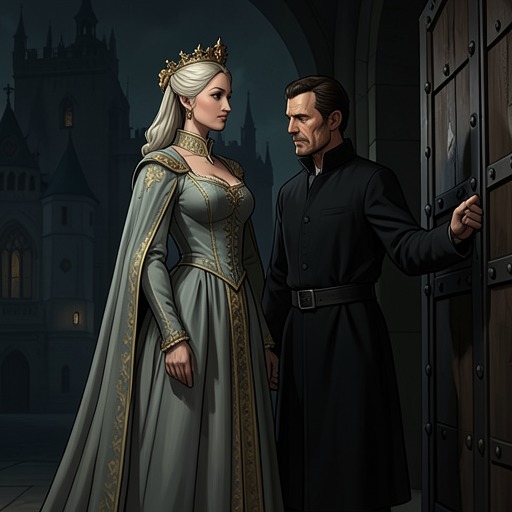
Anne of Austria and George Villiers relationship
The Three MusketeersAnne of Austria and George Villiers relationship is one of the novel’s defining tensions between private devotion and public sovereignty. Their attachment is emotionally intense but politically impossible: Buckingham pursues the queen across national and dynastic boundaries, while Anne must confront the danger that their meetings expose her honor, his life, and the stability of the royal court. The relationship therefore advances through rare encounters, charged memories, urgent separations, and material tokens whose value exceeds their physical form.
Secret Attachment and Unequal Freedom
Buckingham approaches Anne of Austria with the confidence of a powerful man accustomed to overcoming obstacles. He has succeeded in coming near her repeatedly and in making himself loved by dazzling her, yet his position cannot erase the barriers surrounding her. When the queen appears through a concealed door, Buckingham is overwhelmed by her beauty and kneels to kiss the hem of her robe. The scene makes their unequal freedom visible: he can travel, risk disgrace, and force an encounter, whereas she must remain conscious of her position as queen, wife, and guardian of royal honor.
Anne immediately separates the present meeting from the forged summons that brought Buckingham to her. She tells him that she did not cause him to be written to, and she insists that he has placed both his life and her honor in danger by remaining in Paris. Her language identifies the forces dividing them as the sea, the hostility between kingdoms, the sanctity of vows, and the obligations attached to royalty. She therefore frames separation not as a lack of feeling but as the only action compatible with duty. Buckingham, by contrast, interprets the barriers as an argument for the exceptional power of their love.
Memory, Repetition, and Desire
Buckingham sustains the relationship through memory because actual meetings are so scarce. He tells Anne that he possesses little beyond memory and that each sight of her becomes a new diamond enclosed in the casket of his heart. Over three years he has seen her only four times: at an earlier encounter, at the mansion of Madame de Chevreuse, in the gardens of Amiens, and in the present meeting. The arithmetic of these meetings gives his devotion a ritual structure. Rarity does not diminish the attachment; it turns each encounter into a treasured object and makes absence part of the relationship itself.
The memory of Amiens is especially dangerous because Buckingham treats it as proof of mutual love. He recalls walking with Anne beneath a beautiful night sky, feeling her hair touch his cheek, and believing that she was about to reveal the grief and isolation of her life. He declares that she loved him on that evening, while Anne answers that the place, the evening, and the force of his gaze may have overwhelmed her, but that the queen came to the aid of the woman who faltered. Her recollection preserves the event while rejecting Buckingham’s interpretation. The same scene is thus both their shared memory and a dispute over what that memory means.
Buckingham repeatedly converts uncertainty into certainty. When Anne denies having declared her love, he invokes their similar dreams and presentiments as evidence that their existences touch at the heart. His reasoning turns bodily and emotional intensity into a claim about destiny. Anne cannot confirm the claim, but neither can she simply dismiss its emotional force. Her response is an anguished admission that she does not know whether she loves him, followed by an unequivocal refusal to break her vows. The relationship’s central pattern emerges here: Buckingham treats ambiguity as hope, while Anne treats ambiguity as a reason for restraint.
Separation as Protection
Anne’s demand that Buckingham leave is both rejection and protection. She begs him to go because his presence in France makes him vulnerable and makes her vulnerable with him. She tells him to return only as an ambassador or minister, surrounded by guards and servants capable of defending him. A sanctioned public role would not remove the emotional danger, but it would place his presence within a form the court could recognize. Her proposed solution shows that she is not merely seeking escape from him; she is trying to preserve the possibility of seeing him without allowing private desire to become public scandal or a cause of death.
Buckingham promises to depart, but his promise contains a future threat to the separation Anne has imposed. He says that within six months, if he is not dead, he will see her again, even if he must overturn the world. The vow expresses devotion, but it also confirms the danger that Anne fears: Buckingham’s love is inseparable from defiance, political movement, and the willingness to risk his life. He leaves through the assistance of Madame Bonacieux, who conducts him out of the Louvre under the same precautions that enabled the meeting. Their relationship therefore depends on secrecy, intermediaries, and routes through spaces that royal authority is supposed to control.
The Casket and the Politics of Gifts
Before Buckingham leaves, Anne returns to her apartment and brings out the rosewood casket bearing her cipher in gold. She gives it to him as a remembrance, and he receives it on his knees. The casket condenses the relationship into a portable object: it is private, royal, and marked by Anne’s identity, yet it can travel with Buckingham after she has compelled him to depart. Its function is not simply sentimental. It creates a material bond across separation and gives Buckingham something that can stand for the queen when direct contact is forbidden.
The casket also becomes part of the larger chain of royal gifts and political obligations surrounding the relationship. During the mission to recover the queen’s diamond studs, Buckingham keeps the casket while providing d'Artagnan with the replacement studs, explaining that the casket is more precious because it is all that remains to him. The distinction is revealing: the diamonds are instruments of public repair, while the casket is the irreducibly private remnant of his attachment. The queen’s gift thus survives as an intimate object even while the diamonds are reproduced to protect her public appearance.
When d'Artagnan later explains that a diamond came from the queen, he insists that it did not come from an enemy and that Anne gave it to him herself. The jewel’s circulation demonstrates how the lovers’ private danger is displaced onto political agents and messengers. Royal objects move through hands, missions, and disguises; each transfer may preserve Anne’s honor or expose the secret that threatens it. The relationship is consequently sustained not by open possession but by controlled transmission, concealment, and the hazardous interpretation of tokens.
Narrative Significance and Unresolved Ending
Anne of Austria and George Villiers relationship is built from a contradiction that the plot never resolves into ordinary domestic fulfillment. Buckingham is convinced that their hearts were formed for one another, yet Anne submits her conduct to vows, rank, and the consequences of international hostility. Their intimacy is real in its emotional force, but it cannot become a stable public union. The queen’s refusal, her gift of the rosewood casket, and Buckingham’s promise to return create a cycle of approach and separation rather than a completed romance.
The relationship also supplies the political motive force for the diamond mission. Because Buckingham’s presence endangers Anne and because the royal ball requires her to display the diamond studs, a private attachment becomes the cause of urgent movement across borders. D'Artagnan’s journey, the reproduction of the studs in London, and the concealment of the casket all show how personal feeling is converted into diplomatic crisis and logistical action. The lovers’ secrecy does not remain private; it organizes the conduct of courtiers, servants, guards, and rival powers.
Its emotional structure is therefore neither simple mutual confession nor simple denial. Buckingham pursues, remembers, interprets, and vows; Anne cautions, refuses, protects, and nevertheless gives him a token of remembrance. The casket preserves what her words attempt to end, while his departure temporarily obeys the command he cannot inwardly accept. Their relationship remains suspended between love and duty, presence and absence, gift and danger—a private bond whose very impossibility gives it continuing power over the public plot.